Jen Cruse: Art Nouveau Horn Combs

By Jen Cruse:

The Art Nouveau period was a turning point in design principals where imagination and free-flowing creativity were of the essence. The emphasis was on a return to hand craftsmanship and away from increasing industrialization. In Europe between c. 1895 and 1910, a revival in the use of horn was led by René Lalique, Lucien Gaillard and their contemporaries.

Clarified horn bleached with hydrogen peroxide, sometimes frosted, was their favoured material. These innovative artists created some of the most imaginative and naturalistic designs ever seen, and their influence spread around Europe to other like-minded artists. Hair combs and pins especially gained enormous recognition owing to their supreme quality and are much sought after by collectors today. The Gulbenkian Museum in Lisbon, Portugal, has a most impressive collection of Lalique’s work, including a great number of his combs.

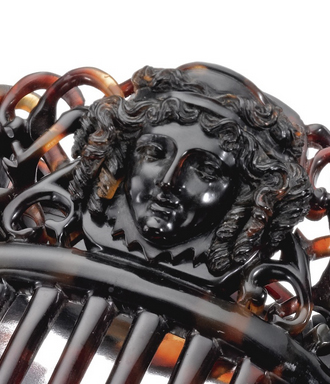
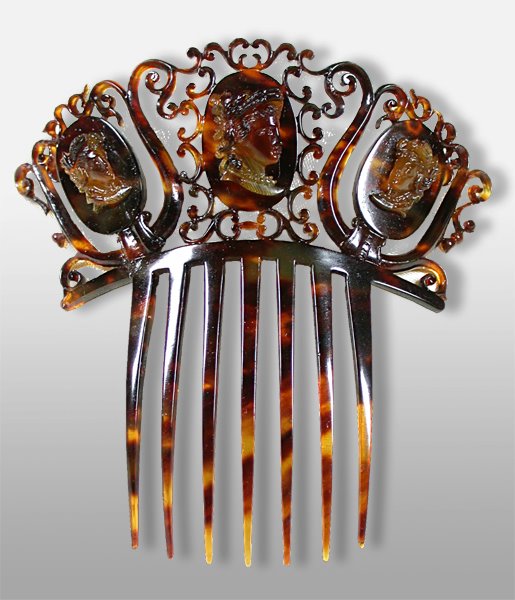
The 2 bleached horn combs featured in the photograph display tinted openwork with daisy flowers and a dragonfly. They are carved in the style of the Parisian Art Nouveau artist/designers. Although unsigned, they have been attributed to Mme E Bonté working in the early 1900s.

Horn Combs of Elizabeth Bonté. Ht 3½in/8.9cm to 4in/10.2cm.

कंघी

For more scholarly research, please examine

The Comb: Its History and Development, by Jen Cruse

Posted in Art Nouveau, French Hair Comb | Tagged , , , | Leave a comment

Ebay: Empire Comb Prices

After the big September 23rd auction, there have been three French combs, c.1790 – 1850, which went for varying prices. The one that sold for $315 was a steal because the photograph did not show its complexity, nor my instinct that there were pearls dangling from the gilt circles decorated with lapis flowers. Here is the record of what sold, when, and for how much:

Coral Empire comb. Superb Condition. Sold: $1045.51, Oct. 5, 2011. Ebay France.

French Tiara comb with pearls and lapis jewels surrounded by seed pearls, c. 1800, Sold: $616.58, Oct. 5, 2011, Ebay France.

French Empire comb, lapis enamel flowers on gilded silver with dangling pearls, excellent condition, Sold: $315, Oct. 6, 2011, Ebay.com

Posted in Auction, E-Bay, Empire Comb, French Hair Comb | Tagged , , | 2 Comments

Ebay: David Andersen, Norwegian Jeweler

The plique-a-jour enamel top looks like a Tiffany stained glass window. It was made by Norwegian jeweler Arthur Andersen, c. 1924 – 1939. His father, David Andersen, started a gold- and silversmithing company in Christiania, now Oslo, in 1876. Arthur took over the company in 1901, when his father died, and put a hyphen in the name: David-Andersen. He also introduced plique-a-jour enameled silver pieces with amazing success.

This is a superb hair pin: magnificent technique, beautifully designed and proportioned, and brilliantly colored when backlit. The dealer is selling it for 1600 Euros on Ebay Germany.

कंघी

For more scholarly research, please examine

Collectible Silver Jewelry by Fred Rezazadeh

Posted in Arthur Andersen, David Andersen, Norwegian hair comb | Tagged , , , , | Leave a comment
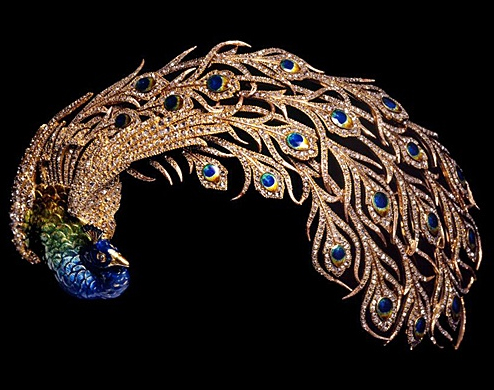
Ebay: Art Deco Bird Comb

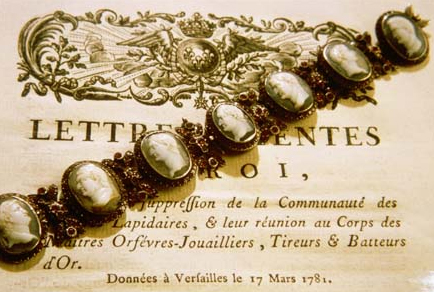
It’s on E-bay for $229 or best offer. I’m not recommending anyone buy it at that price, or at all, but I love this comb, c. 1930. I think it has humor, pizzazz, and is an excellent example of American celluloid art.

कंघी

For more scholarly research, please examine

The Creative Museum’s virtual exhibition on American brilliant combs.

Posted in American Hair Comb, celluloid with rhinestones | Tagged , , , | 2 Comments

Museum Combs: Egypt, New Zealand, India, and Germany

I would like to feature four museum combs today. The first comes from the Egyptian Museum in Cairo. It belonged to the King Wadj, whose name means serpent. His tomb was found near the ancient city of Abydos. He was the third King of the First Egyptian Dynasty and ruled c. 2920 BC. In the comb’s carvings, you can see two serpents.

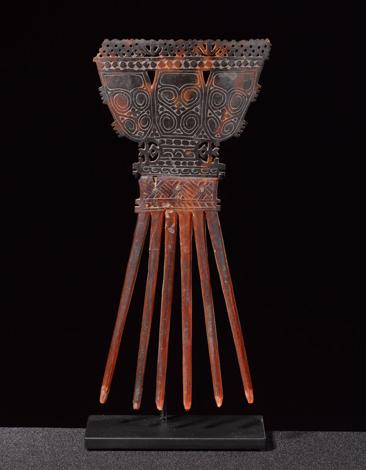
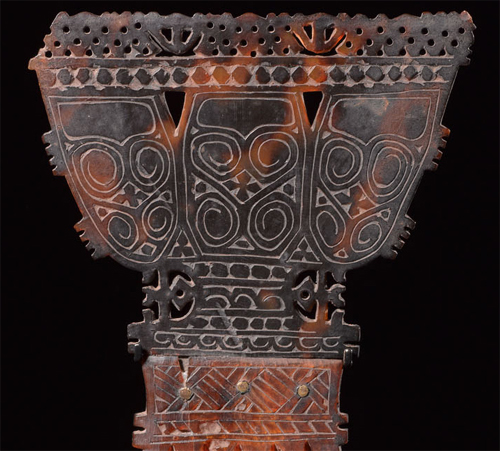
Our next work was made by Maori master Patoromu Tamatea. This bone Heru comb resides in New Zealand’s Museum of Wellington’s City & Sea under the collector’s, instead of the artist’s name.

Next are two marvelously shaped combs from the Raja Dinkar Kelkar Museum in South India. Both were made from the 18th to 19th Centuries.

And last is a breathtaking liturgical comb, which belonged to Saint Heribert (970 – 1021). He was Archbishop of Cologne (Köln) and considered a saint in his lifetime. Pope Gregory VII canonized him c. 1074. This crucifixion comb is one of the prizes in Köln’s Schnütgen Museum and was made in the second half of the 9th Century.

कंघी

For more scholarly research, please examine

Pharaohs Of The First Dynasty Of Egypt, including: Menes, Narmer, Qa’a, Djer, Hor-aha, Djet, Den (pharaoh), Merneith, Anedjib, Semerkhet, Ancient Egyptian Boats (first Dynasty) – Abydos

Carved Histories: Rotorua Ngati Tarawhai Carving

Pune Culture, including: Kasba Ganapati, Sawai Gandharva Music Festival, Raja Dinkar Kelkar Museum, Culture Of Pune, Sudarshan Rangmanch, Dagadusheth Halwai Ganapati Temple, Baajaa Gaajaa

Fragmented Devotion: Medieval Objects from the Schnutgen Museum in Cologne

Posted in Egyptian hair comb, German Hair Comb, Indian Hair Comb, New Zealand Hair Comb, Patoromu Tamatea | Tagged , , , , , , , , | Leave a comment

Matilde Poulat: Taxco Artist, Mexican Silver Comb

Born in Mexico City and better known as Matl, Maestra Matilde Poulat started making jewelry in 1934. She became one of the most famous artists of the Mexican Silver Renaissance. Detailing and texture gave her art a delicacy and intricacy few achieved during the the Taxco era. She decorated her pieces with coral and turquoise jewels. This Poulat hair comb also has an amethyst cabechon, the fertility sign of two birds facing each other, a tortoiseshell comb, and I made a deal with the seller at a reduced price to buy it over time, within my means. This is my pick to add to my collection.

कंघी

For more scholarly research, please examine

Heritage Fine Silver & Vertu Auction #5016

William Spratling and the Mexican Silver Renaissance: Maestros de Plata

Posted in Mexican Hair Comb | Tagged , , | 2 Comments

Creative Museum: Folk and Personal Combs

By The Creative Museum:

Nous ouvrons toujours des yeux émerveillés devant des peignes qui méritent le titre d’œuvre d’art. Nous admirons la beauté et la richesse des matériaux, la perfection des formes, le savoir-faire des orfèvres qui créent ces véritables bijoux.

Mais c’est un autre sentiment tout particulier qui nous saisit devant les témoignages d’art populaire.
Ils nous parlent des traditions d’une région et nous font saisir l’âme des gens.

Un peigne confectionné par une personne individuelle nous touche par sa charge sentimentale. On est ému par ses maladresses de formes et de façon. On cherche à déchiffrer le sens de ce qui est représenté. C’est une pièce destinée au départ à une personne précise. Mais elle a pu traverser les générations et elle est alors porteuse de toute une histoire. Si nous laissons notre imagination vagabonder, on peut en voir le film.

Ce peigne peut être naïf, les matériaux peuvent être de vil prix. Et pourtant il devient un objet de valeur par le fait qu’il est unique.

कंघी

For more scholarly research, please examine

American Folk Art by William C. Ketchum Primitive and Folk Jewelry by Michael Gerlach
French Folk Art by Jean Cuisenier


Posted in Creative Museum, Folk Art, hair comb | Tagged , , | 1 Comment

Paul-Gabriel Liénard and Louis Aucoc

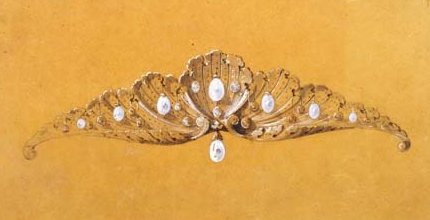
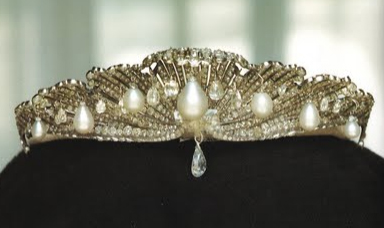
Paul-Gabriel Liénard was a Parisian Art Nouveau jeweler, who reached the top of his craft when he registered his own mark in 1905. As with Louis Aucoc, Liénard was well known for using pearl sprays. I have not found any documentation connecting Aucoc and Liénard except for these three combs. They were made from translucent horn and seed pearls, so light would show through, and the jeweled accents would keep them lightweight. In addition to philosophical influences, there was a practical purpose to these decisions. The combs would be easy to wear.

Liénard’s example, with his maker’s mark, sold at Christies for $21,600 in 2006.

Aucoc’s comb is on sale at The Tadema Gallery for around $8000.

Both combs are superb expressions of the natural world’s asymmetrical shapes.

Christie’s estimated the value of this Aucoc hair pin at £3000 to £4000 in 2009.

To prove how scholarship creates value, I recorded this sale on E-bay in 2007. Comments are welcome, but I believe these hair pins were made by Aucoc. They were damaged, as all the seed pearls were not present. However, the only identification was “French work, 1900.” The dealer was, shall we say, homework-deficient? I remember this auction well, and when I saw the price, well, it was a lot like the recent auction we have all been talking about.

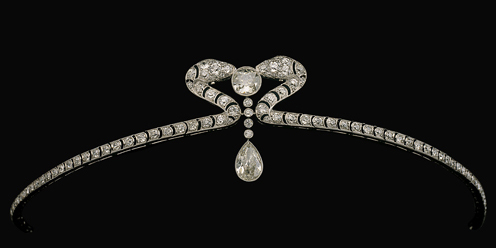
And just for jaw-dropping fun, I’ll revisit this Liénard tiara, made of gold, horn, pearls, and diamonds, which sold for $60,000 at Christie’s in 2009.

कंघी

For more scholarly research, please examine

The Comb: Its History and Development by Jen Cruse, page 35, which I’m proud to say is listed in the Tadema Gallery’s provenance for the Louis Aucoc comb.

Imperishable Beauty by Yvonne J. Markowitz

Posted in Art Nouveau, French Hair Comb | Tagged , , , , | Leave a comment

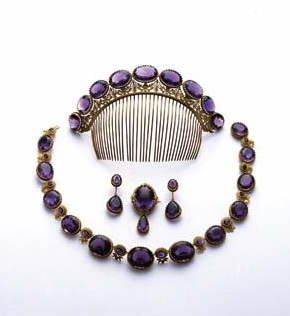
That Ebay Auction: It was an Amethyst Empire Comb

The stones were amethysts. Shall we compare the comb in this Empire parure on a historical jewelry site to the one that went for $458 in that E-bay auction?

The comb correctly identified.

The amethyst Empire comb that went for $458 on Ebay.

कंघी

For more scholarly research, please examine

Tiara by Diana Scarisbrick

Napoleon’s Letters to Josephine, 1796-1812

Catalogue Des Bijoux Du Musee Napoleon III (1862)

Posted in Auction, E-Bay, Empire Comb, French Hair Comb | Tagged , , , , | 2 Comments

Creative Museum: Exhibition at the Musée d’Angoulême

Online community is still miraculous. In addition to publishing superb books, our devotion to the beauty and cultural revelation of combs is being recognized by museums.

Thirty combs from the Creative Museum join headdresses from the private collection of Antoine de Galbert for a “world tour” exhibition at the Musée d’Angoulême. En Tête à Tête: Parures de tête à travers le monde (English translation: From Head to Head: Headpieces from Around the World) will show from October 1 to December 31, 2011.

Noticing our online achievements, curators are realizing that hair combs “mark the beat of life… are privileged witnesses to cultural identites… and are immersed in a magical vision.” We did it. We’re walking in the front door. Today is a glorious day. Hi Birds. :-)

कंघी

For more scholarly research, please examine

Prehistoire de la Charente: Les temps ante-historiques en Angoumois a travers les collections du Musee d’Angouleme (French Edition)

Ainsi soit-il : Collection Antoine de Galbert – Extraits

Posted in Creative Museum, Musée d’Angoulême, Museum Exhibition | Tagged , , , , | Leave a comment